
It’s Been 24 Months. Here’s What Google’s AI Features Did to Organic Traffic

.png)
For a minute, you have to drop the “do more GEO” or “SEO is dead” mentality.
The disruption is segmented, so the strategy has to be segmented too. Before reallocating budget, you need to know which part of your search portfolio is being disrupted and which part is still doing its job.
Two stories about Google’s AI search features are circulating, and both come with good numbers attached.
In the first, AI Overviews are an ‘extinction-level event’ for the open web, with named publishers reporting traffic losses of 70, 80, even 89 percent.
In the second, nothing much has broken, because Google’s search revenue is at record highs, the company still holds ninety percent of the market, and the traffic that survives converts better than it ever did.
The two stories cannot both be the whole truth, and the interesting thing is that neither is wrong. They are just describing different segments of the same market.
The Disruption Is Real, and It Has Casualties
The broadest current view of the damage comes from Chartbeat, which aggregates first-party analytics across thousands of publisher sites.
Data shared with Axios in March 2026 showed that referrals from traditional search engines had fallen by 60% for small publishers over two years, compared with 47% for medium-sized publishers and 22% for large ones.
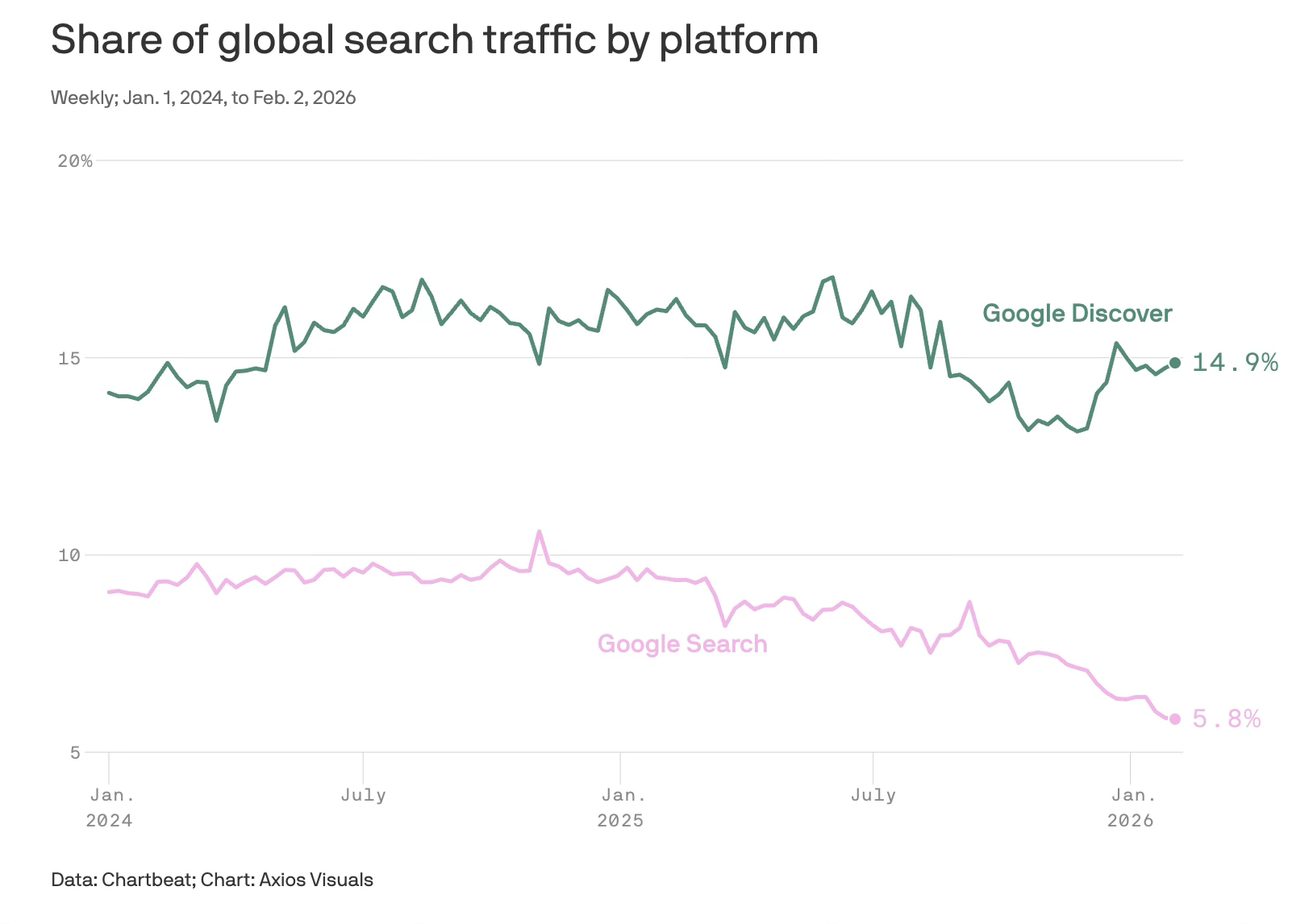
That size gradient is one of the clearest signs that the disruption has not been distributed evenly.
- Larger publishers tend to have stronger brands, more direct traffic and better-developed subscriptions, newsletters, apps and internal recirculation.
- Smaller sites are more likely to depend on Google introducing their work to people who have never heard of them.
However, as search produces fewer referrals, that dependence becomes a liability.
Other popular named brands have also become casualties of this disruption.
HubSpot
HubSpot lost an estimated 70 to 80 percent of its organic traffic between early 2024 and the first half of 2025. Monthly visits fell from around 24 million to 6 or 7 million.
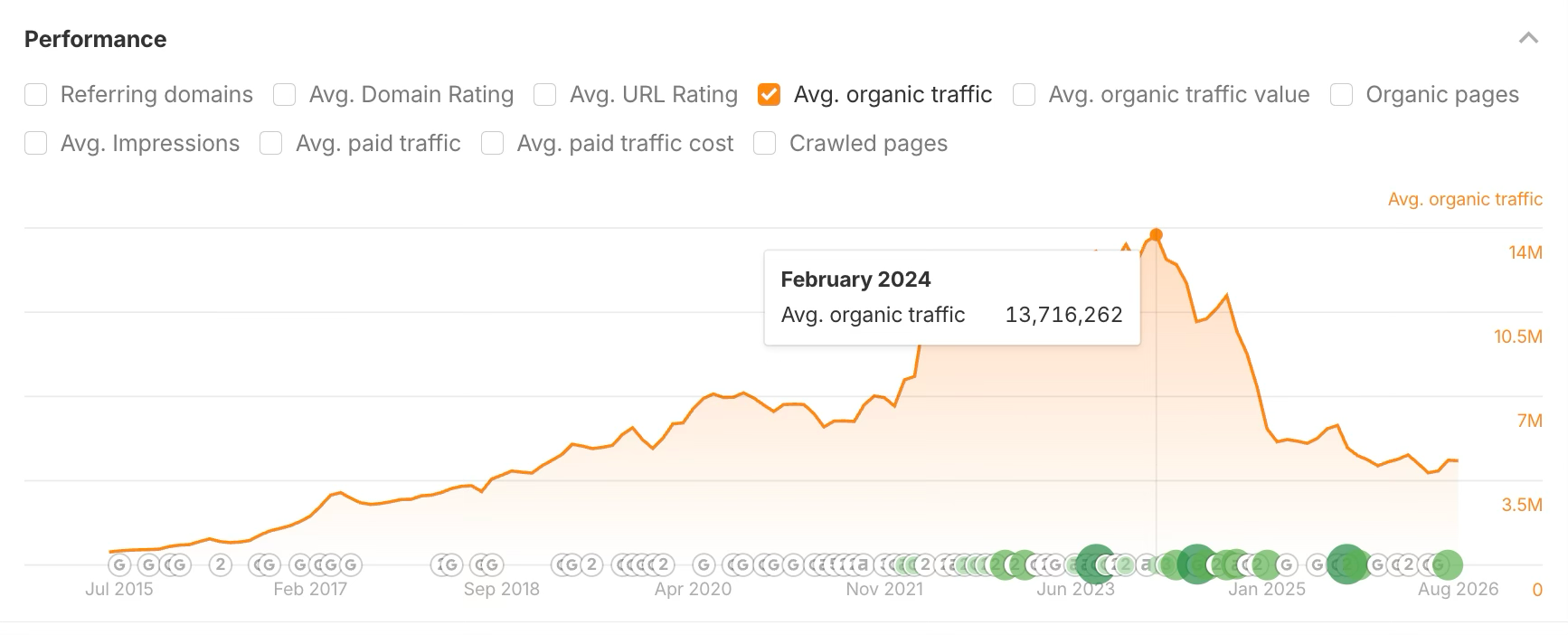
In HubSpot’s defence, AI overviews and no-click searches have changed informational searches —which it was known for.
Business Insider
Business Insider’s organic search traffic fell 55% between April 2022 and April 2025, according.
Due to this, the company had to cut approximately 21% of its workforce, with its CEO describing the business as exposed to extreme traffic changes outside its control.
The timing does not establish that AI Overviews alone caused the decline, but it illustrates what falling platform referrals can mean for a publisher whose economics remain tied to page views.
Chegg
Chegg reported that its non-subscriber traffic was down 49% year over year in January 2025, compared with an 8% decline in the second quarter of 2024.
It explicitly blamed Google’s AI Overviews for retaining traffic that previously reached Chegg and filed an antitrust lawsuit against Google.
Daily Mail
Daily Mail’s 89% figure is more dramatic and more narrowly defined. In a research submitted by its parent company to the UK Competition and Markets Authority, Daily Mail found that UK desktop CTR fell from 25.23% when no AI Overview appeared to 2.79% when an AI Overview appeared and included a visible Daily Mail link.
New York Times
The New York Times also took a hit. Perhaps not as damaging as the most (at least from how it reacted to it).
For reference, organic search accounted for almost 44% of its desktop and mobile traffic in 2022. By April 2025, the share had fallen to 36.5%.
The Times did not lose search visibility on the scale of a small informational publisher, but even one of the strongest media brands in the world became less dependent on Google over the period.
At the sector level, the decline is difficult to explain away as a collection of isolated failures.
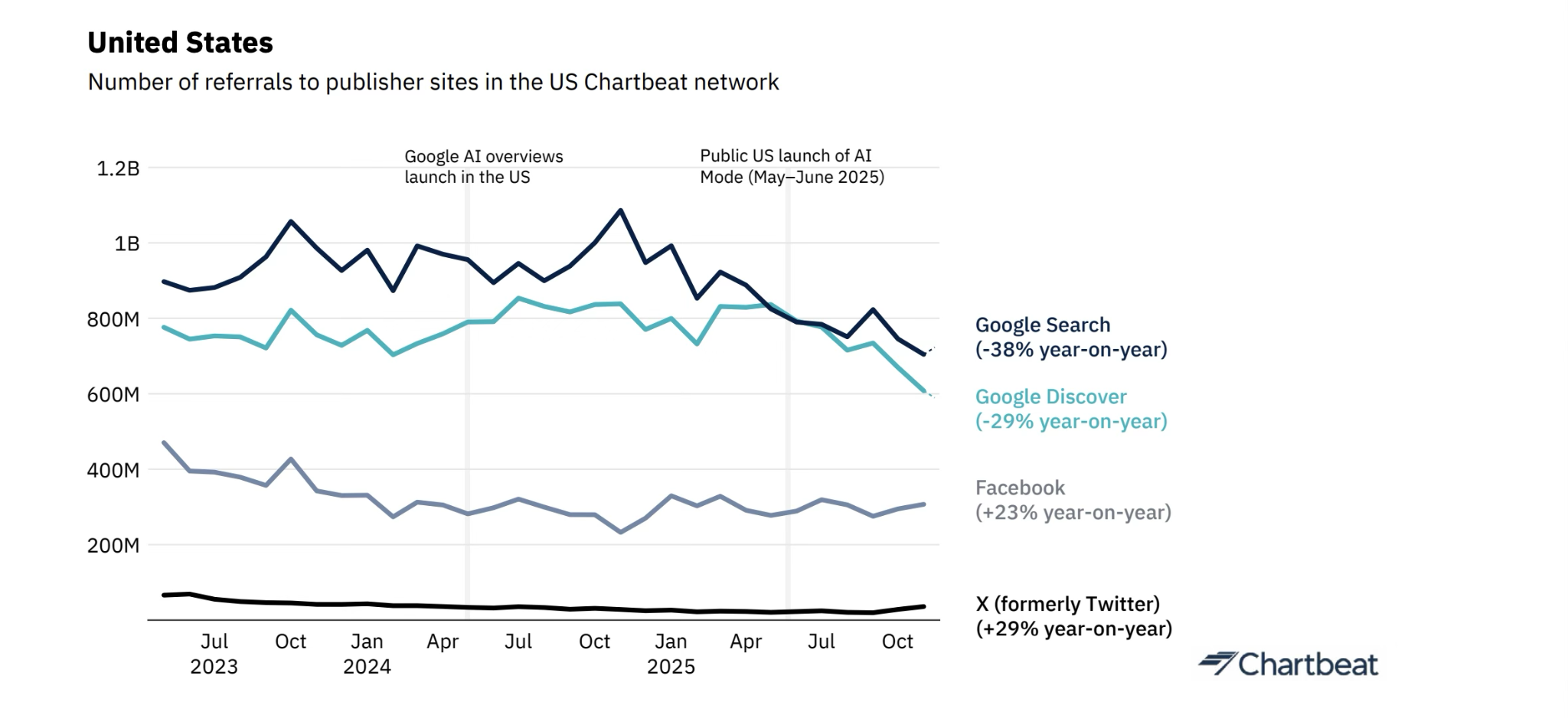
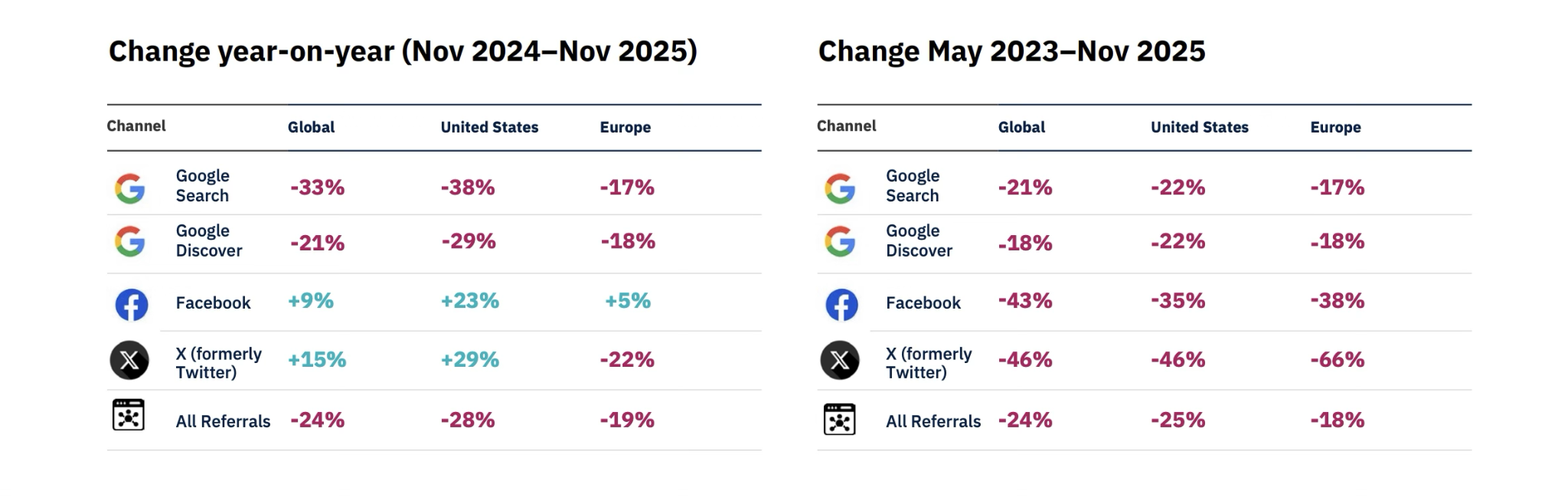
Chartbeat data covering more than 2,500 sites showed that organic Google traffic fell 33% globally between November 2024 and November 2025.
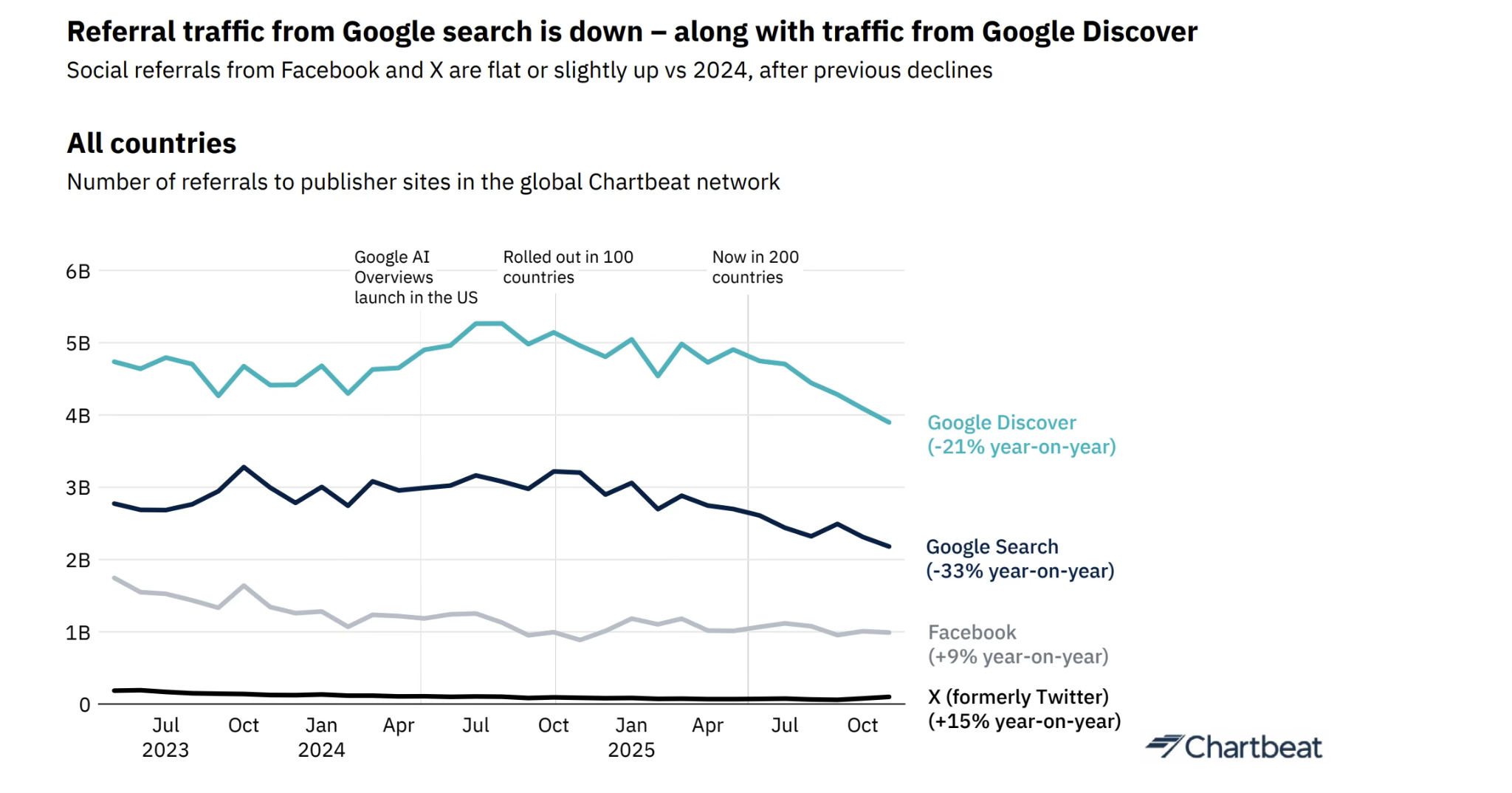
In the United States, it fell 38%. These are publisher figures rather than a measurement of the entire open web, but the sample is broad enough to show that something structural has changed in the distribution of online attention.
The aggregate zero-click numbers confirm this is structural rather than anecdotal.
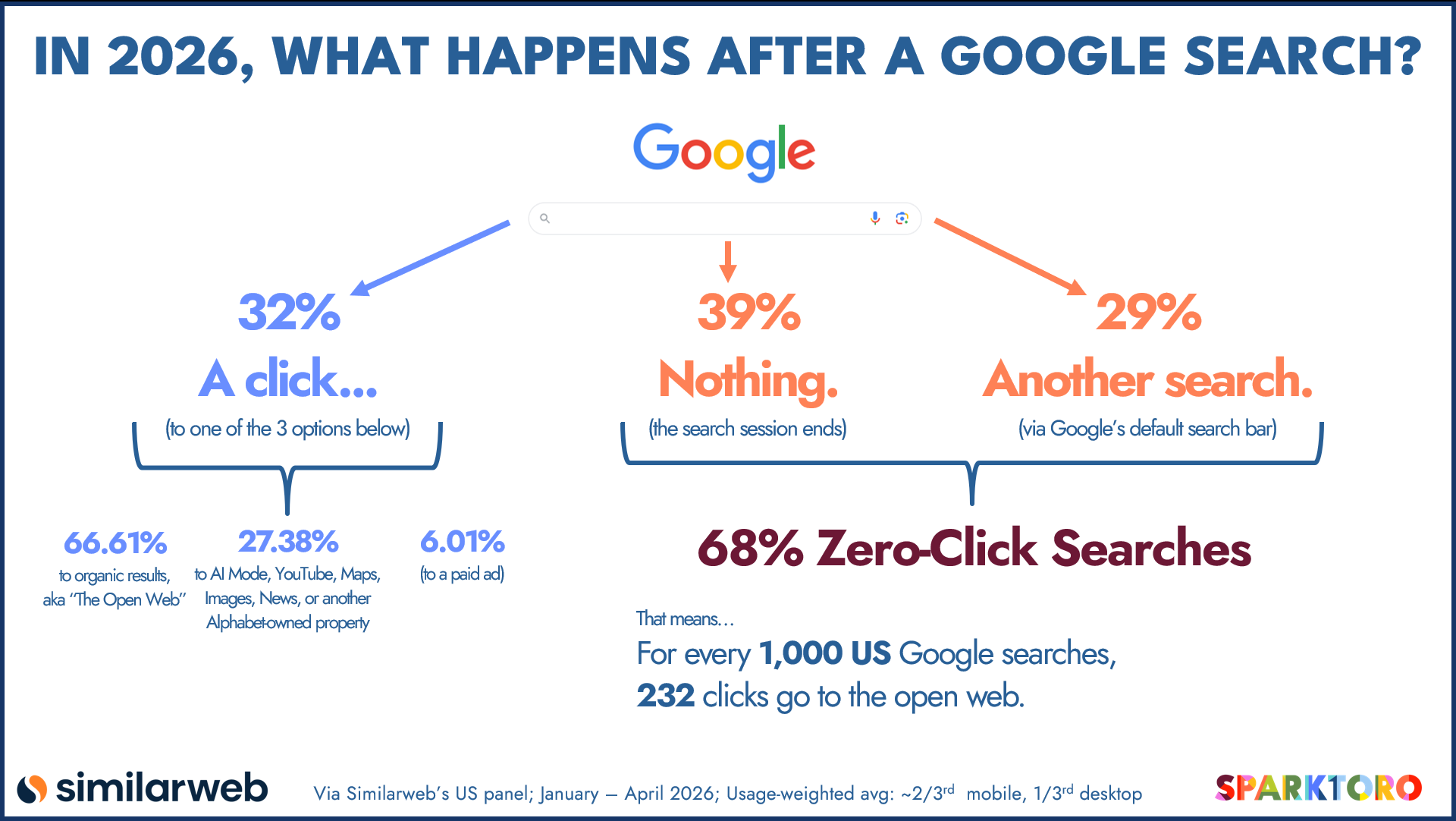
SparkToro, working from Similarweb’s clickstream panel, found that 68 percent of Google searches ended without a click in the first four months of 2026, up from around 60 percent in 2024.
Even Ahrefs’ opt-in panel of more than 75,000 domains, all run by professional marketers actively working to grow traffic, showed the traffic share Google sends them falling about 22 percent between mid-2025 and mid-2026.
When the sites trying hardest to grow are still losing ground, the effect is not a skill problem.
What Actually Got Hit
The aggregate decline is severe, but averaging it hides the most useful finding for anyone deciding where to spend.
The damage has not fallen evenly across search intent. Generic informational queries were hit first and hardest, while branded and action-oriented searches have held up considerably better.
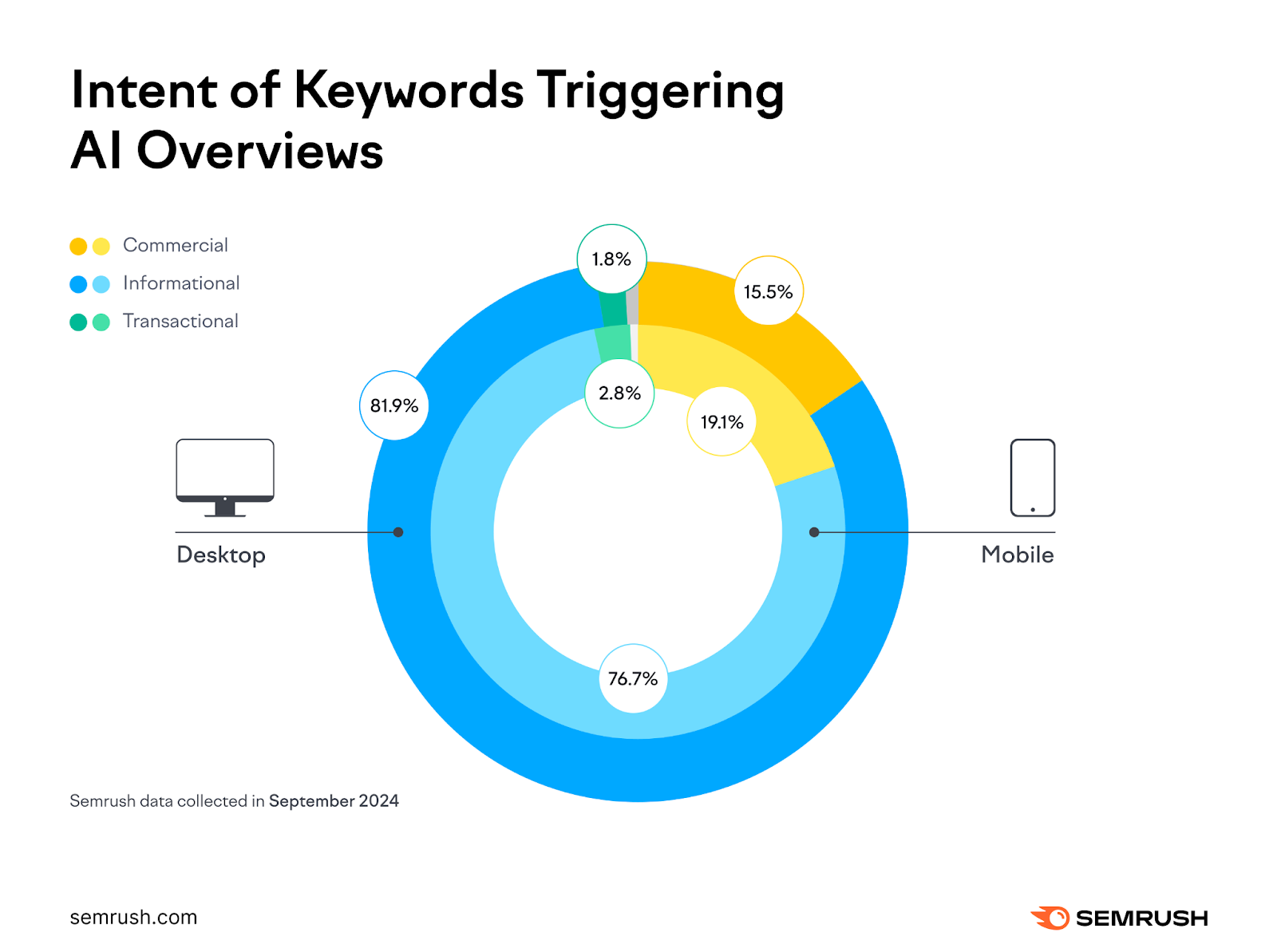
But that boundary is beginning to move. We can see this concentration in Semrush’s data. Its analysis of more than 10 million keywords found that;
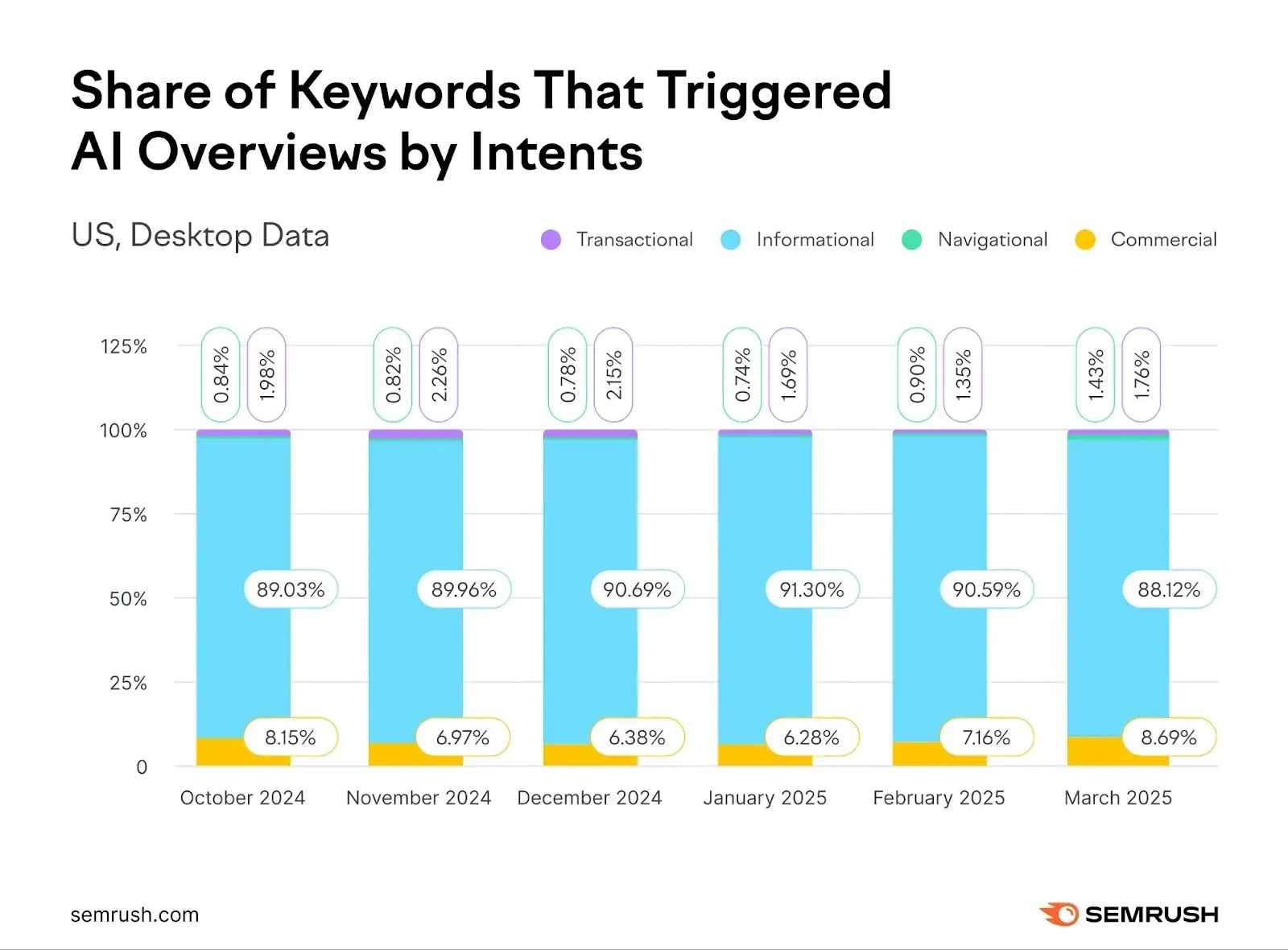
- 88.1 percent of queries triggering AI Overviews were informational, compared with 8.69 percent commercial, 1.76 percent transactional and 1.43 percent navigational.
Nearly 95 percent of AI Overview keywords also either carried no ads or very little commercial value.
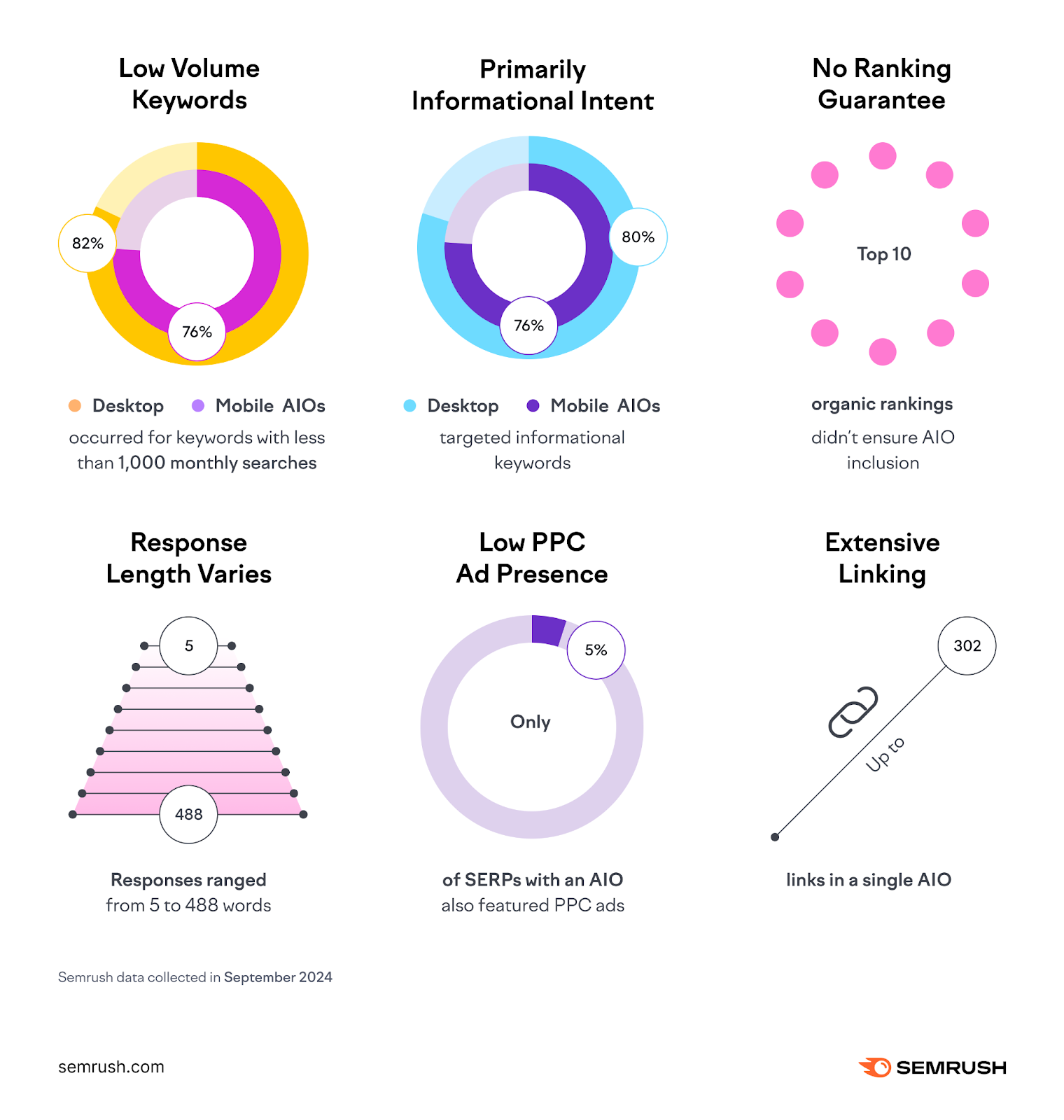
These are exactly the searches where Google can plausibly finish the job itself:
- what something means,
- why something happens,
- how a process works, or
- the basic answer to a question.
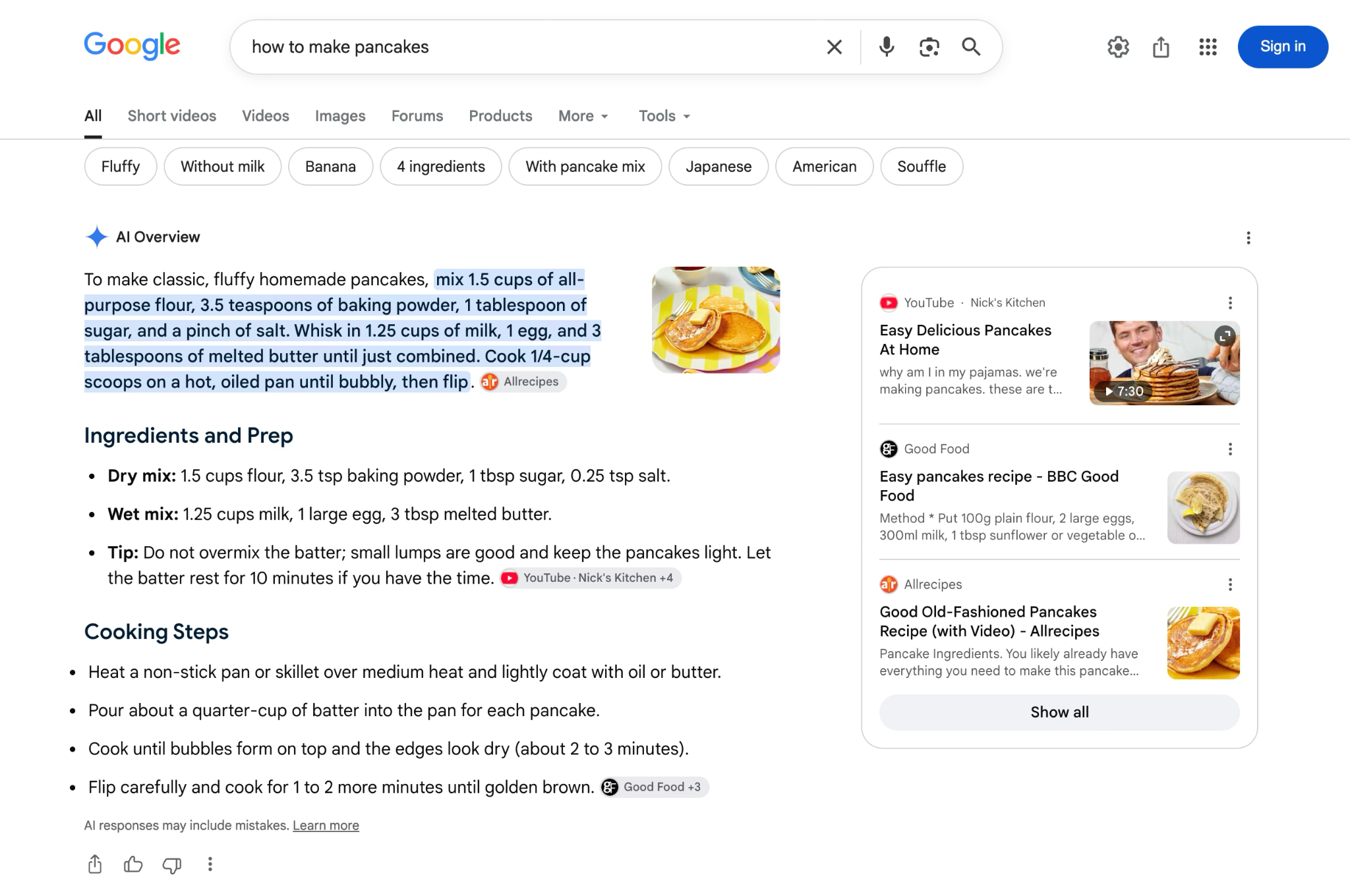
A definition or simple how-to can be compressed into five paragraphs at the top of the results page.
The pattern extends to the branded-versus-unbranded split.
Amsive analyzed roughly 700,000 keywords across ten sites and found that only 4.79 percent of branded keywords triggered an AI Overview.
- Non-branded terms that did trigger one suffered an average 19.98 percent decline in CTR.
- Branded queries went the other way. When an AI Overview appeared, CTR actually increased 18.68 percent.
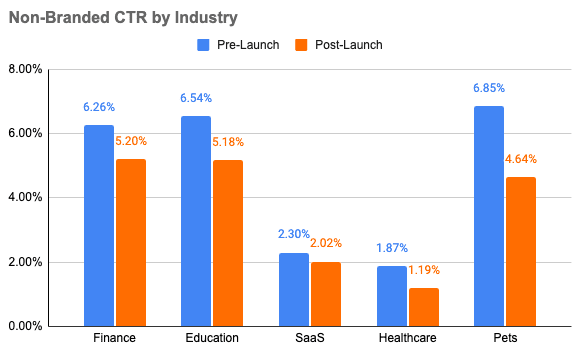
My thesis is, a brand people already know and search for by name sits largely outside the blast radius.
There is even evidence that Google itself found the limits of the format.
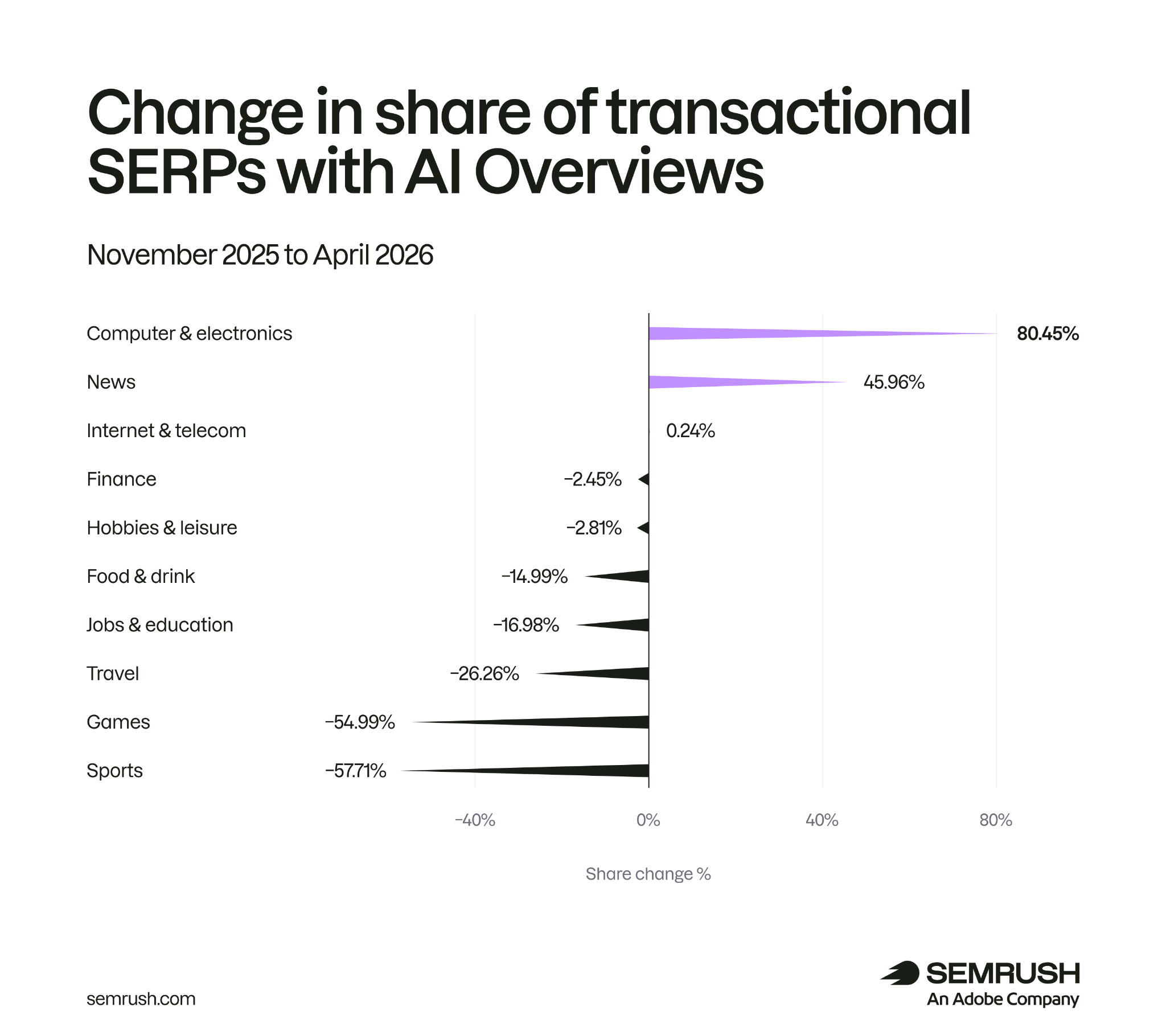
E-commerce queries, which drew AI Overviews on a meaningful share of searches early on, saw the feature pulled back as Google apparently discovered that AI answers on shopping queries did not convert into sales.
Rankings Didn’t Change, But the Click Was Intercepted
Understanding why the losses feel so disorienting requires seeing the mechanism, because it broke a relationship marketers had relied on for years
In many cases, rankings did not disappear and impressions could remain healthy. What changed was the number of people who converted that visibility into a visit.
What we have now is that the click is increasingly being intercepted before the user reaches the traditional result.
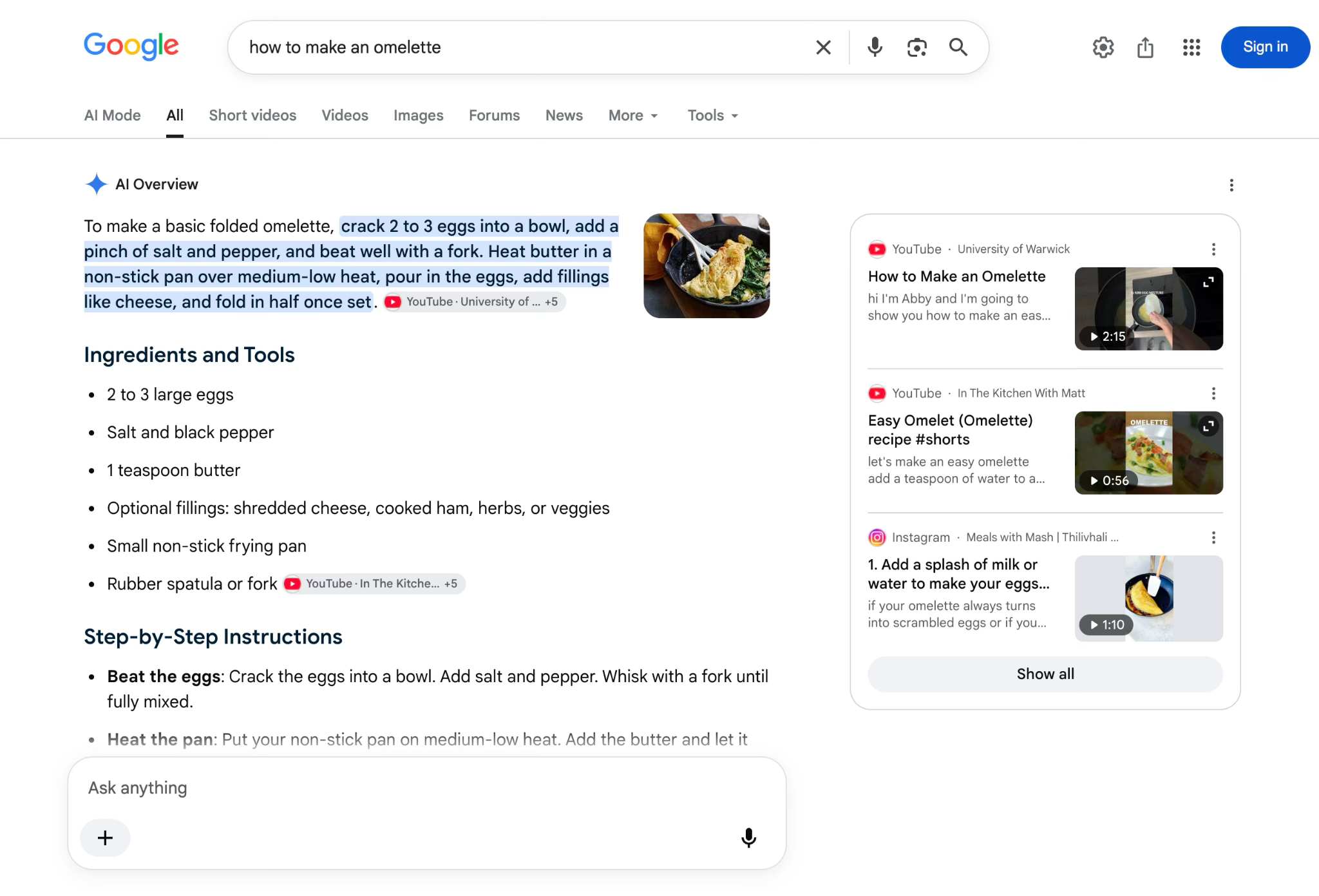
For example, when I type ‘how to make an omelette’ I get a detailed breakdown on the process. I have no incentive to click anything unless I choose to. That wasn’t the case a few years back. Best you get is a featured snippet.
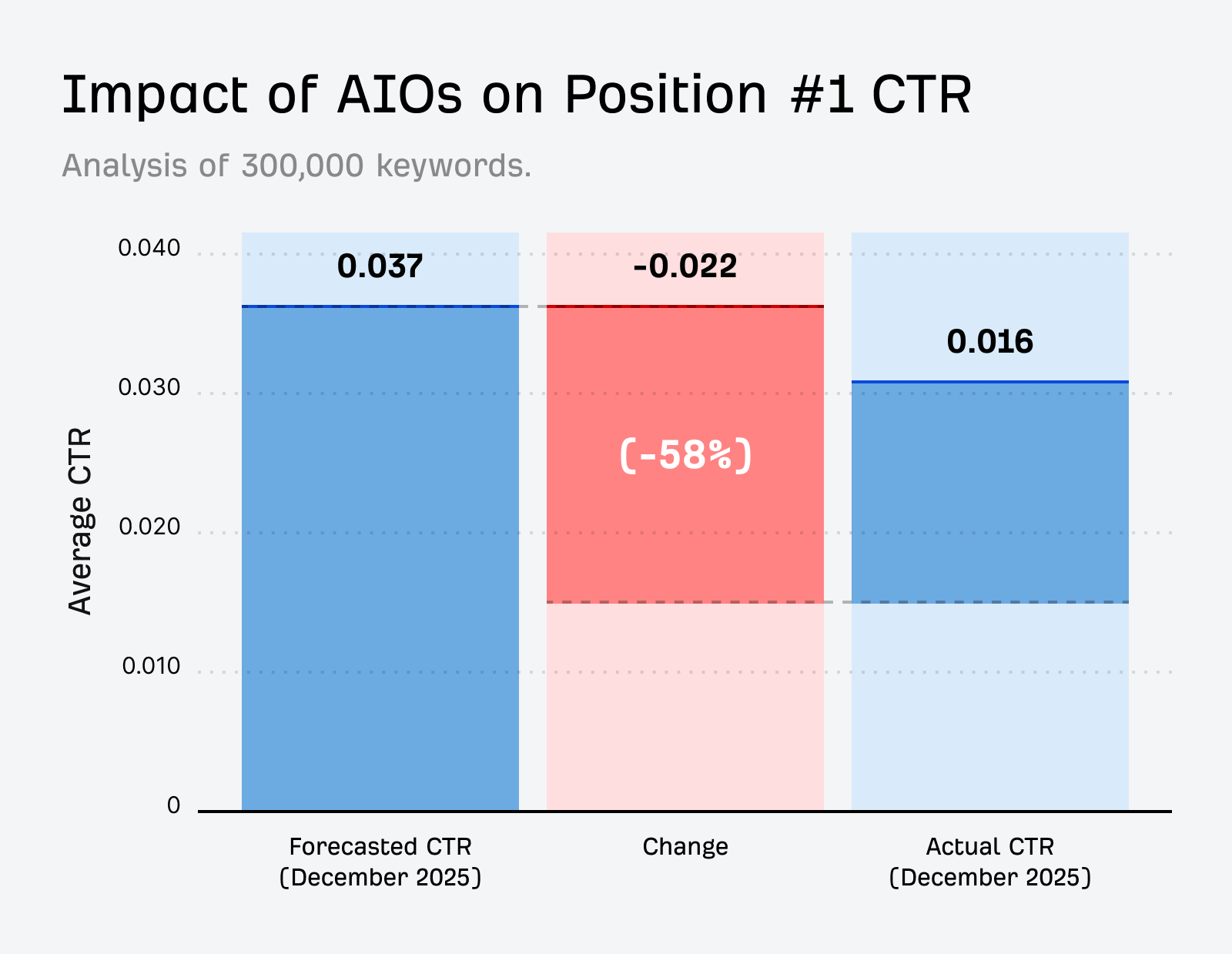
To confirm this no-click pandemic, Ahrefs studied 300,000 keywords and found that, by December 2025, the presence of an AI Overview correlated with a 58 percent lower click-through rate for the top-ranking page.
Recommended watch: Why Traffic Alone Doesn’t Cut It Anymore | AirOps & Gaetano DiNardi
The Winners Nobody Talks About
The doom narrative treats the losses as universal, and the data flatly contradicts that. The same evidence base that contains HubSpot at minus 80 percent also contains sites that grew.
The first group is destination-scale sites, where users already have a reason to go.
Graphite’s analysis of Similarweb data across more than 40,000 of the largest US websites found that organic search traffic fell only 2.5 percent overall in 2025, while the ten largest sites actually grew by an average of 1.6 percent.
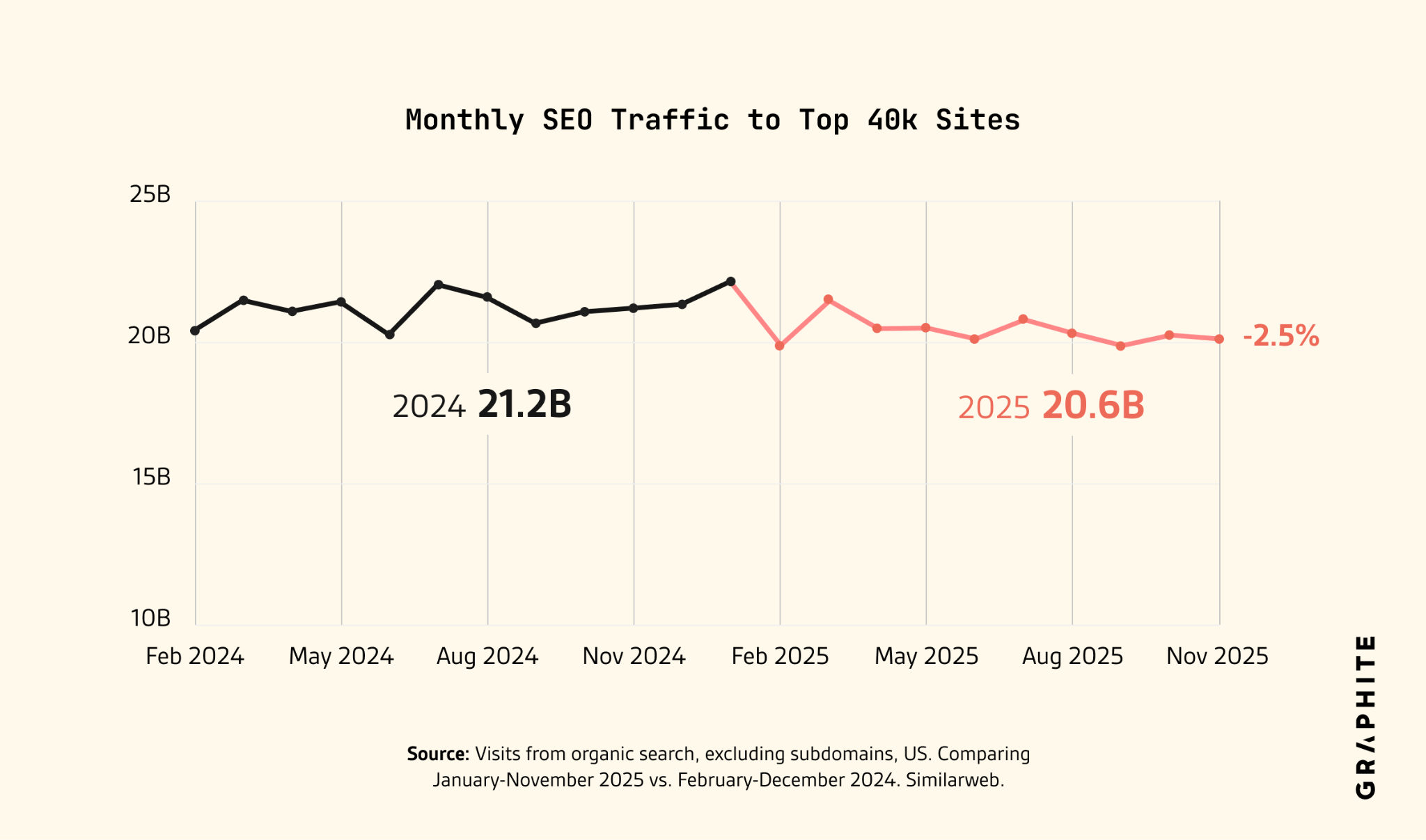
Reddit gained 10 percent, YouTube 5 percent, Instagram 21 percent and eBay 16 percent. The sharpest declines instead clustered among sites ranked roughly between the top 100 and 10,000.
Size is also not an automatic shield, since Quora fell 45 percent, but the distribution makes one thing clear: the middle of the web has been squeezed much harder than its largest destinations.
The second group is sites where the click still performs a job. In the same Graphite dataset, news, health, cooking and entertainment sites lost more than 10 percent of organic traffic, while clothing, shopping and marketplace categories grew.
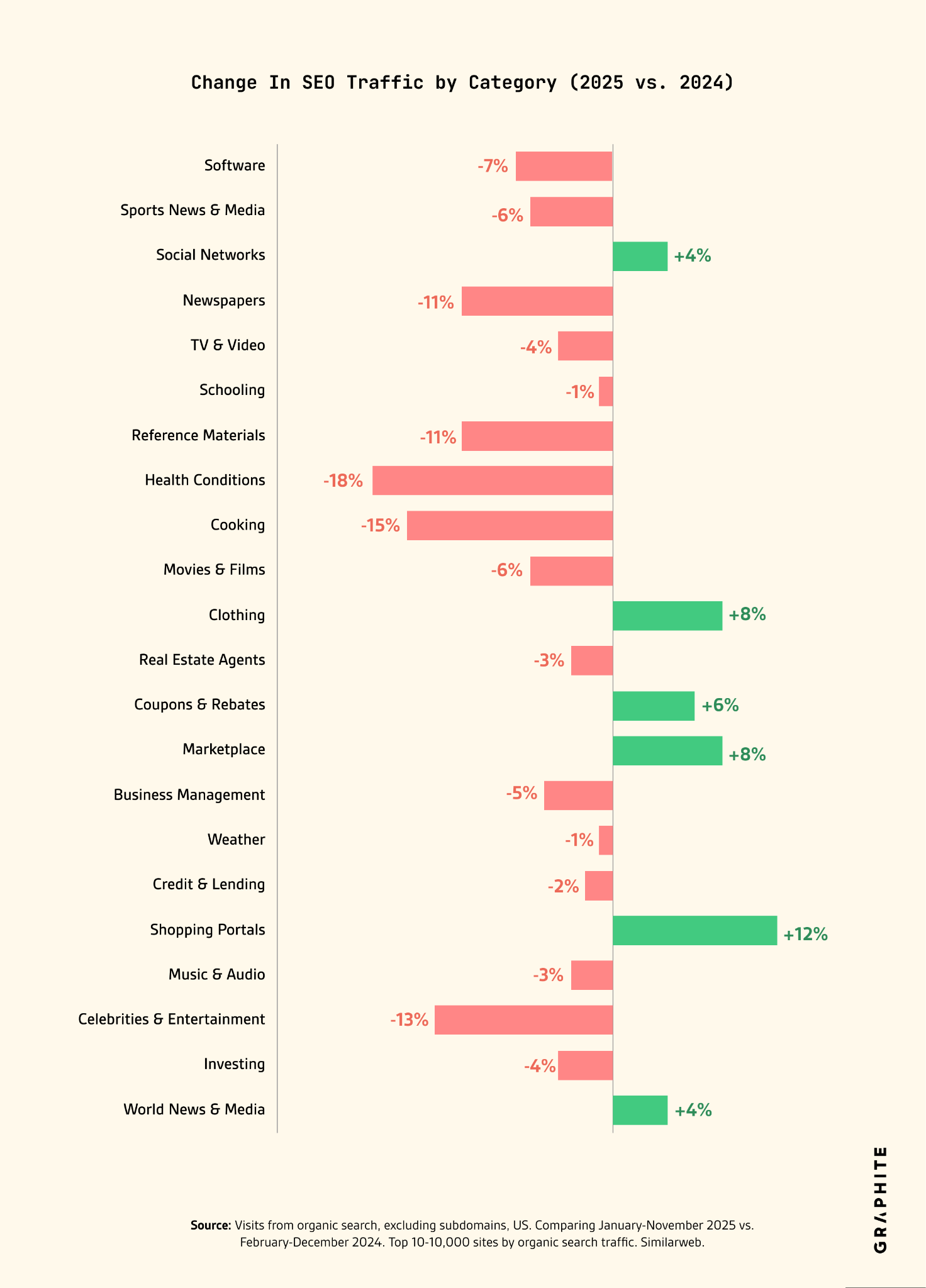
That fits the intent pattern from the previous section.
Google can summarize a definition, recipe or basic health question before the click. It cannot complete every shopping journey, browse a marketplace on the user’s behalf or remove the need to inspect a product.
The more useful the destination itself is to completing the task, the harder the click is to eliminate.
The third group is brands people already intend to find. If we refer back to Amsive study, we’ve already seen that AI Overviews are considerably more dangerous when Google is mediating discovery between a user and a brand they do not yet know.
Meanwhile, once the user arrives looking for someone specific, the summary has much less power to replace the destination.
Then there is a fourth group, the brands Google puts inside the answer itself.
Seer Interactive found that when a brand was cited in an AI Overview, organic CTR averaged 0.70 percent versus 0.52 percent when the Overview appeared without citing it, roughly 35 percent more clicks.
Paid CTR was 7.89 percent for cited brands versus 4.14 percent for uncited ones, a 91 percent difference.
Citation did not restore the old click pool, and Seer explicitly warns that the study cannot prove citation itself caused the uplift. Organic CTR was still 1.45 percent on queries with no AI Overview at all.
But once an Overview exists, being named inside it is clearly associated with capturing a larger share of what remains.
Is AI Search Replacing the Lost Clicks?
The natural hope is that the clicks disappearing from Google are simply reappearing somewhere else, through ChatGPT, Perplexity, Gemini, Claude and the rest.
Well, not so much. While the referrals are growing fast, they’re still nowhere near large enough to replace what was lost, and here’s why:
The volume is still tiny
In Chartbeat’s New Traffic Report, page views from Google Search fell 34% while referrals from ChatGPT grew more than 200%.
But still, all chatbots combined still accounted for less than 1 percent of publisher referral page views.
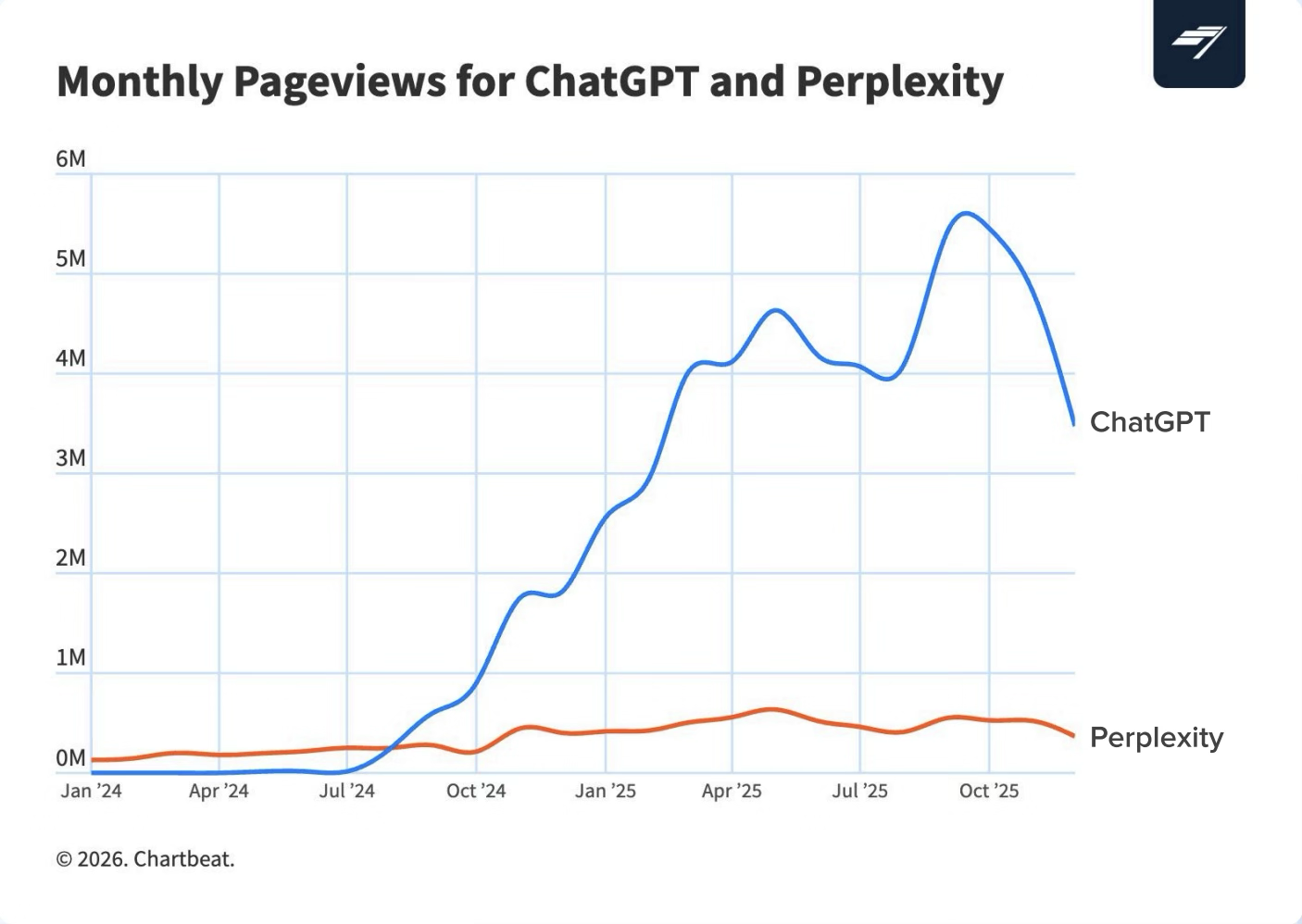
A channel can triple and remain commercially small when it starts close enough to zero.
In another report, Similarweb estimated that AI platforms sent 1.13 billion referral visits to the world’s top websites in June 2025, up 357 percent year over year. Google Search sent roughly 191 billion referrals over the same period, about 170 times as many.
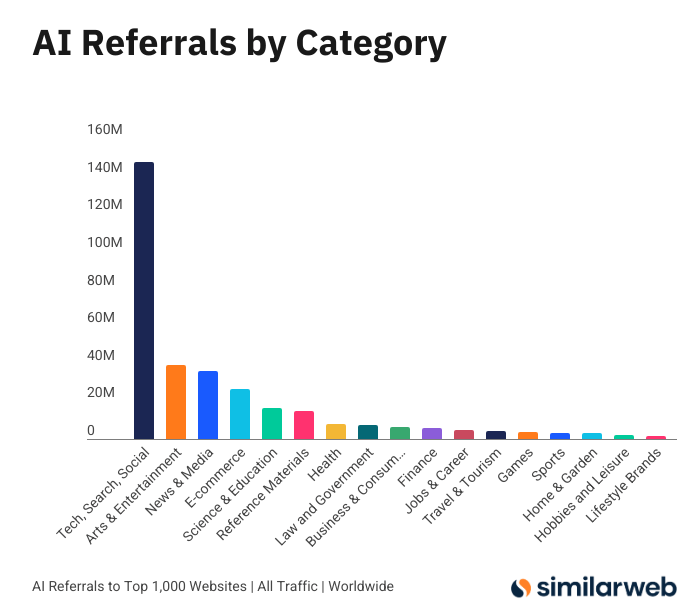
Previsible’s analysis of nearly two million LLM-referred sessions put AI traffic at just 0.13 percent of total sessions, roughly one visit in every 769.
That makes the ‘Google replacement’ thesis difficult to prove. In fact, Google referrals can fall by double-digit percentages while AI referrals grow by triple digits and the scales still do not come close to balancing.
The growth is worth watching
If we still go back to Chartbeat’s earlier data, we can see that ChatGPT’s referrals to publishers grew more than 200 percent year over year.
Also, AI search traffic overall is expanding many times faster than organic. And Wix’s tracking put AI search visits up nearly 43 percent year over year into early 2026.
However, that’s still less than 1 percent of their site traffic, even after growing roughly fourfold in one year.
Regardless, a small base growing that fast reaches significance eventually.
There is also a measurement problem. Google counts links and clicks from AI Overviews and AI Mode inside Search Console’s overall Web search data. So historically, they were difficult to separate from conventional organic search.
Thanks to the gods-of-Google, they began rolling out a dedicated Generative AI Performance report in June 2026. But it currently focuses on AI-feature impressions and is still available only to a subset of properties.
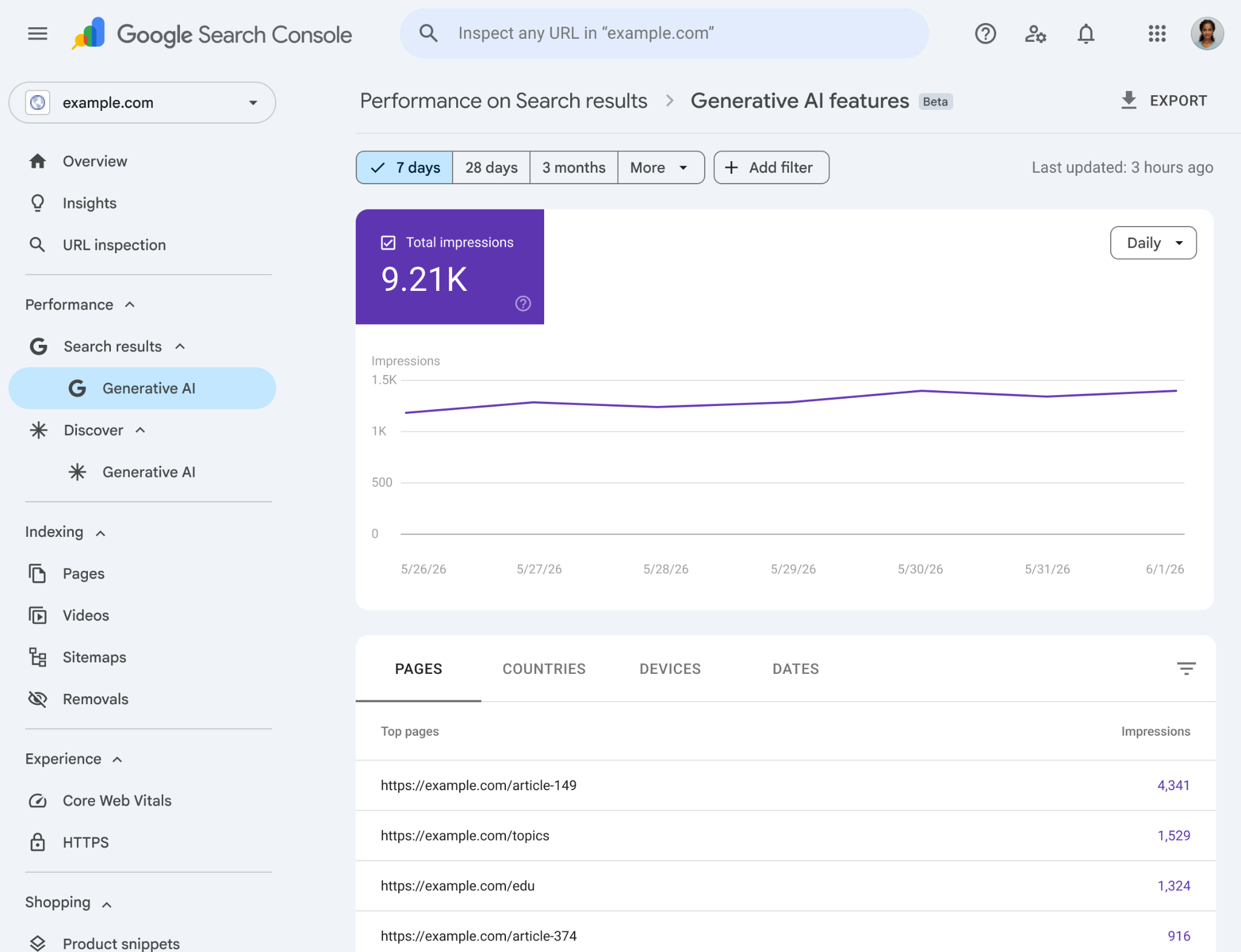
I think that just makes visibility easier to isolate than it was a year ago, but the attribution problem is still unsolved.
I also think some AI-assisted discovery will disappear from referral reports entirely.
For example, a person can discover a company in ChatGPT and later search the brand on Google, type its URL directly, or copy a link into another browser.
GA4 classifies visits without a clear referral source as direct traffic.
We know that this undercount exists; what we do not know is whether it is large enough to materially change the overall volume gap.
The traffic may be better, but the evidence still looks mixed
I’m more concerned about what happens when an AI user actually does click. The general idea is that AI-referred visitors convert at a premium. This is largely because the engine handled the early research inside the chat window and the user who clicks through is already deep in a decision.
A good example of this referral traffic is from my friend Nathan, a freelance writer for B2B SaaS companies.
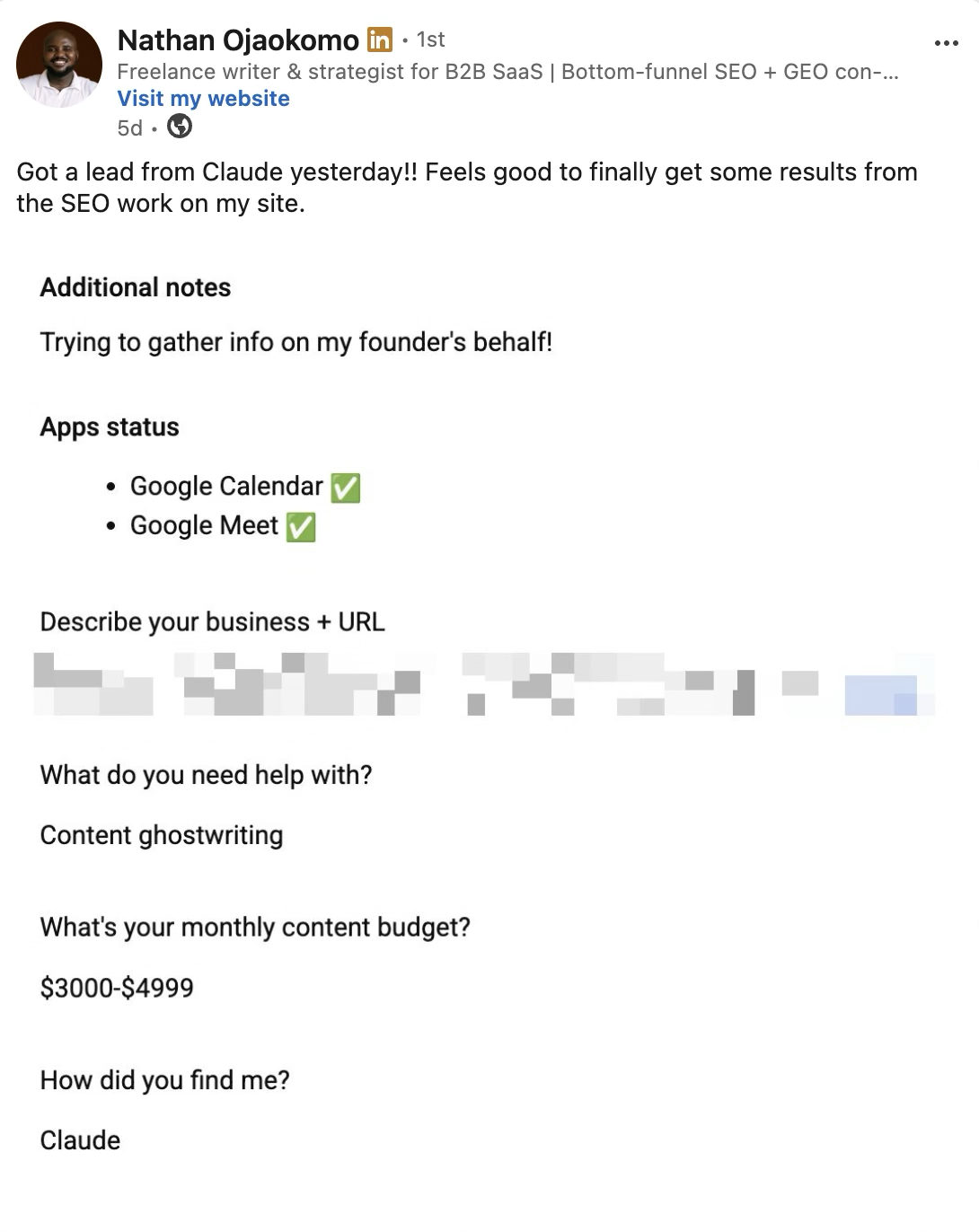
Now, how do you wager the likelihood of a conversion? I’d guess pretty high.
Similarweb’s cross-site analysis put the AI referral conversion rate at 11.4 percent against 5.3 percent for organic search, a bit more than double.
Semrush reported a 4.4x value premium. Ahrefs, in an internal case study, found AI visitors driving 12 percent of signups from half a percent of traffic, which works out to a 23x conversion edge.
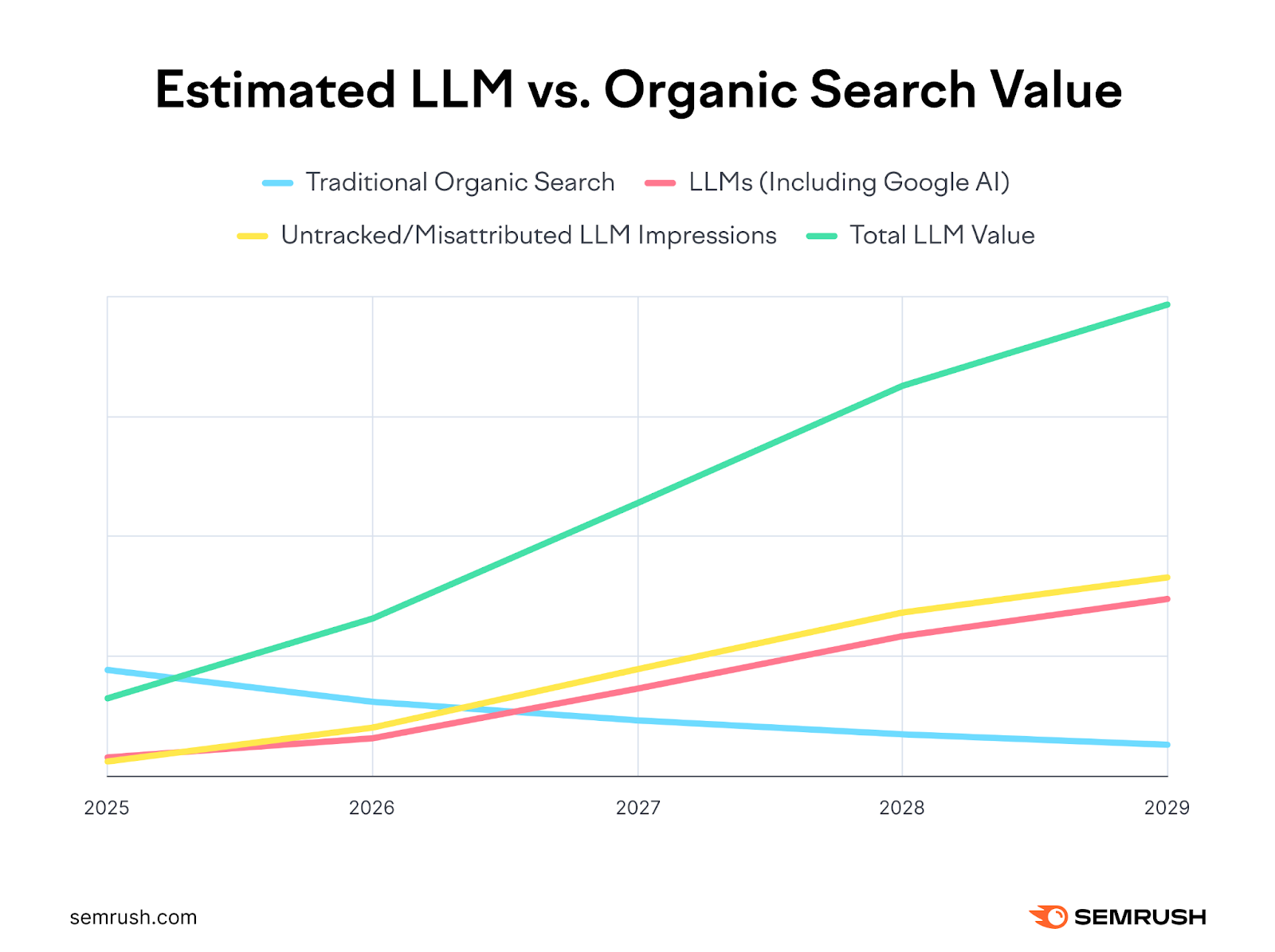
The range from roughly 2x to 23x is wide enough that we can almost guarantee that AI search offers premium referral.
However, there is meaningful evidence in the other direction.
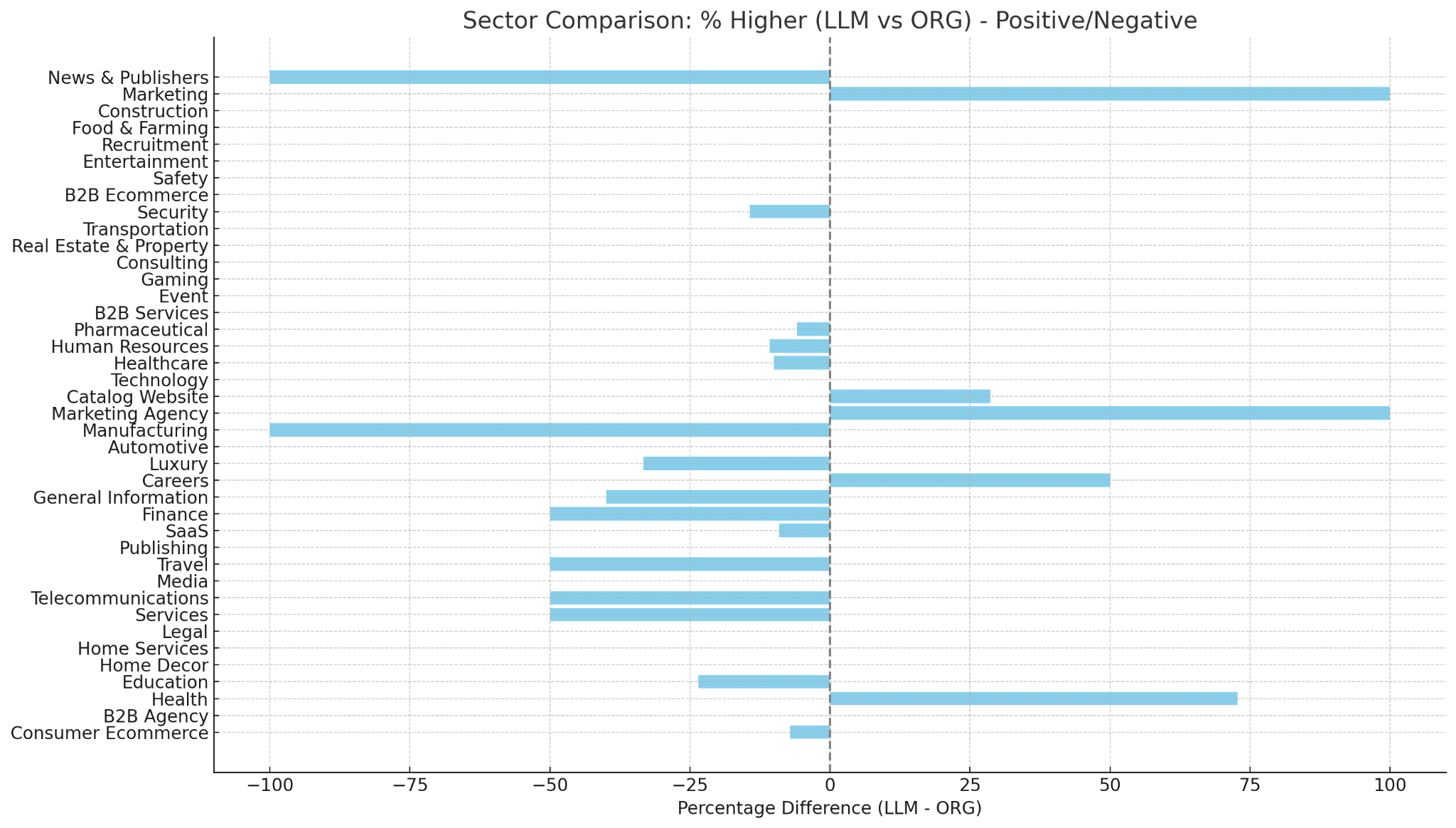
SALT.agency analysed nearly 672,000 LLM referral sessions against more than 188 million organic sessions across 40 sectors. They found that organic search produced a higher key-event conversion rate in most categories.
LLM traffic won in areas such as careers and health, while SaaS was essentially tied at 6.69% for LLM traffic against 6.71% for organic. Consumer ecommerce and travel both favoured traditional organic traffic.
And the referrals will not come through one source
The engines behind those referrals do not behave alike, which complicates any single strategy for capturing them.
In my own Fan-Out research, tracking how ChatGPT, Gemini, and Perplexity assembled recommendations across 270 queries, the engines pulled sources so differently that a brand’s odds of being the cited, clicked result varied sharply from one to the next.
For example:
- 33 percent of ChatGPT citations came from listicle and affiliate content,
- 51 percent of Gemini’s came from vendor and brand websites,
- while Perplexity spread 376 citations across a much broader mix of vendors, review sites, forums, listicles and other sources.
That means whatever share of lost Google discovery eventually migrates into AI will not arrive through one replacement channel.
A brand can be highly visible in Perplexity and weak in ChatGPT, or dominate Gemini because of its owned content while disappearing from another engine whose retrieval system favours third-party sources.
For now, then, AI search is not replacing the lost click at anything close to one-for-one.
It is creating a much smaller stream of referrals that is growing quickly, distributed unevenly across engines and, in some contexts, disproportionately valuable when it arrives.
What’s Next for Marketing Leaders?
For a minute, you have to drop the “do more GEO” or “SEO is dead” mentality.
The disruption is segmented, so the strategy has to be segmented too. Before reallocating budget, you need to know which part of your search portfolio is being disrupted and which part is still doing its job.
Let’s start with diagnosing the problem
Split search performance by;
- branded versus non-branded queries,
- informational versus commercial and
- transactional intent, and asset type.
Then identify which important queries trigger AI Overviews and compare their impressions, rankings, CTR and conversions with queries that do not.
A site losing sessions on non-branded informational content is experiencing something structural. While a site losing sessions on commercial pages likely has a different problem entirely.
Reallocate content toward searches where the click still matters
Since the losses concentrate in top-of-funnel informational content and the commercial core holds up, the content investment should shift accordingly.
In this case, toward comparison content, bottom-of-funnel queries, product and pricing pages, and original research that a summary cannot fully absorb.
This is not a reason to abandon informational content, which still builds the authority that earns citations, but it is a reason to stop treating broad educational scale as automatically safe.
Compete for the answer layer as well as the ranking
Given that cited brands earn a 35 percent click premium inside overviews while uncited brands beneath them lose the click, the objective shifts from ranking to being the source the summary names.
That means tracking citation frequency alongside rank, and structuring content so it is the cleanest available answer to the specific question, since the overview pulls from whoever it can extract most confidently.
Build channels Google cannot intercept
The publishers that held up best were the ones with strong direct and branded demand, which is the structural defense against a search engine that increasingly answers in place.
Email lists, brand recognition, and audience relationships that do not route through Google’s results page are worth more now than at any point in the SEO era, precisely because they sit outside the click economy that is being compressed.
Stop using traffic as the scorecard
Sessions still matter, but they can no longer carry the whole evaluation.
If AI Overviews suppress low-intent clicks while higher-intent search continues to perform, total traffic can decline faster than business value.
The reverse can also happen—i.e., a site can retain impressive traffic while losing the queries that actually create pipeline.
The reporting layer therefore needs to connect traffic, intent and outcome.
Track conversions and revenue by landing-page type, branded versus non-branded search, CTR relative to impressions and rankings, AI visibility and citation share, and ultimately pipeline or revenue generated by the content portfolio.